

When starting a sportswear or apparel brand, one of the first questions you might ask is:
Where are Nike clothes made? And can a small sportswear clothing manufacturer in China produce the same level of quality?
The answer might surprise you.
For startups, finding a factory in the right country is not necessarily the hardest part. The real challenge is finding a manufacturer that can deliver the quality you want, work with your preferred fabrics, and support your order quantity.
1. Where Are Nike Clothes Made?
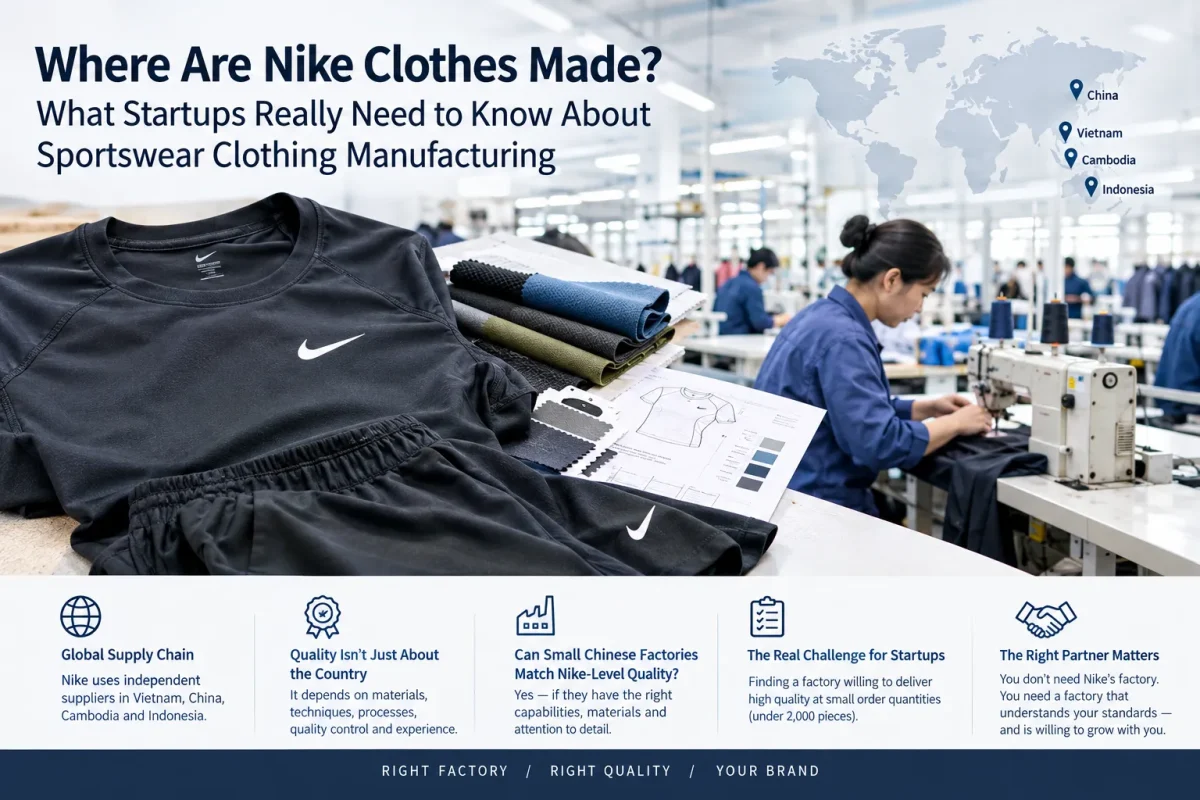
Nike manufactures apparel through a global network of independent suppliers. Its clothing production spans several countries and regions, including Vietnam, China, Cambodia, and Indonesia. The exact manufacturing footprint varies by product category, supplier, and year.
But here’s an important point: the country where a garment is made does not automatically determine its quality.
A factory’s capabilities depend on its technical expertise, materials, production processes, quality control systems, and experience with specific types of apparel.
China, for example, has a well-developed apparel manufacturing ecosystem. From performance fabrics and functional sportswear to cutting, sewing, printing, heat transfers, and specialized finishing, many Chinese sportswear clothing manufacturers have the technical capabilities to produce high-quality garments.
For a startup, the more useful question is not simply where a product is made, but whether the manufacturer can meet your product specifications consistently.
2. Can Small Chinese Clothing Factories Achieve Nike-Level Quality?
Many new apparel brands assume they need to work with a large factory—or even a current Nike supplier—to achieve premium product quality.
That is not necessarily true.
Many small and medium-sized clothing factories in China have strong technical skills and years of manufacturing experience. Depending on the product, they can produce garments that meet demanding quality standards.
However, there is an important distinction between producing a garment of comparable quality and reproducing an established brand’s exact specifications.
If your goal is to develop high-quality sportswear comparable to products from leading athletic brands, you need to pay attention to several factors:
- Fabric and materials: Fiber composition, fabric weight, stretch, breathability, durability, and color consistency.
- Fit and construction: Pattern development, stitching, seam construction, finishing, and garment measurements.
- Quality control: Measurement tolerances, shrinkage, color variation, wash performance, and consistency between production batches.
- Performance testing: Appropriate testing based on the garment’s intended use and performance requirements.
A capable Chinese factory may be able to meet these requirements. But achieving consistent results takes the right materials, clear technical specifications, proper sampling, and a manufacturer willing to work through the details with you.
The question is not simply whether Chinese factories can produce high-quality clothing.
It is whether you can find the right factory to produce your specific product to your required standard.
3. The Real Challenge: Finding a Factory for Orders Below 2,000 Pieces
For many startups, the biggest obstacle is not product quality. It is finding a manufacturer willing to deliver that quality at a small order quantity.
Imagine you want to launch a premium sportswear collection.
You have a specific fabric in mind, a carefully developed fit, detailed stitching requirements, and clear expectations for the finished garment.
But your first order is only 100, 300, or 500 pieces.
This is where things can become difficult.
Many factories capable of producing high-quality apparel are not necessarily willing to take on small, highly customized orders.
There are several reasons for this.
Fabric minimums
Specialized performance fabrics, custom colors, specific compositions, and custom dyeing or finishing processes may require minimum purchasing quantities. Even if a factory is willing to produce 200 garments, sourcing your exact fabric may be difficult or expensive.
Product development costs
Pattern making, sample development, fit adjustments, fabric sourcing, and production preparation all require time and skilled labor. These costs do not disappear simply because the order is small.
Production efficiency
Factories need to manage production schedules, labor, machinery, and material purchasing efficiently. A small custom order can require nearly as much communication and preparation as a much larger one.
As a result, some manufacturers prioritize orders of 2,000 pieces or more, particularly when the products require specialized materials or extensive customization.
This does not mean high-quality small-batch production is impossible.
It means that finding the right manufacturing partner requires more careful selection.
4. The Best Factory for Your Startup Isn’t Always the Biggest One
When searching for a sportswear clothing manufacturer, it is easy to focus on factory size, well-known clients, or claims about supplying major brands.
But a large factory is not automatically the best choice for a startup. A smaller factory is not automatically less capable, either.
What matters is whether the manufacturer can support your particular business model.
Before choosing a factory, consider these questions:
- Can it understand and follow your technical specifications?
- Is it willing to develop samples and make revisions?
- Can it source the fabric you need, or recommend a suitable alternative?
- Does it have a reliable quality control process?
- Is it willing to communicate and solve problems throughout development?
- Can it support your current order quantity and potentially grow with your brand?
For a startup, a manufacturer willing to carefully develop 200 or 500 pieces may be a better partner than a large factory that only prioritizes orders of tens of thousands of garments.
Of course, small orders generally come with higher per-unit costs. Fabric minimums, development expenses, customization, and production complexity all affect pricing.
The goal is to find a practical balance between quality, customization, quantity, and cost.
5. You Don’t Need Nike’s Factory. You Need a Factory That Understands Your Standards.
Nike has an established product development system, a global apparel supply chain, and extensive quality management processes.
As a startup, you do not need to replicate that entire system from day one.
You need to identify the standards that matter most for your own products and work with a manufacturer that can help you achieve them.
Start with one product. Define your fabric requirements, measurements, construction details, finishing methods, and quality acceptance criteria. Develop samples, evaluate the results, and refine the product before moving into bulk production.
The right manufacturer should do more than simply follow an order sheet. Ideally, it should help you identify suitable materials, solve technical challenges, and make informed decisions about production.
For emerging apparel brands, the real competitive advantage is not necessarily access to the biggest factory.
It is the ability to build a reliable manufacturing partnership that delivers the right quality at a quantity your business can afford.
You don’t need Nike’s factory. You need a factory that understands your standards—and is willing to help you meet them, even when you’re starting small.
For startups looking to build a premium sportswear or apparel brand, that can make all the difference.