


Starting an activewear brand is a dream for many entrepreneurs, but the early stages are where most people lose their way. For founders, rather than being crushed by a grand vision, it’s better to stay grounded and move forward step by step. This article breaks down the core dimensions of pre-launch preparation, brand positioning, supplier selection, and sales channels into an actionable framework you can actually follow.
Step 1: Pre-Launch Preparation – Lay a Solid Foundation
Before you officially launch your brand, you need to get the following basics in place:
- Company registration and legal structure: Choose the appropriate business entity (e.g., limited liability company, sole proprietorship, etc.) according to the regulations in your country or region, and complete the registration process.
- Tax and compliance: Understand local VAT, corporate income tax, social security contributions, and other tax policies. If you plan to sell across borders, pay special attention to tax treaties and filing requirements in different countries.
- Import duties and customs policies: If you plan to source finished goods or fabrics from overseas (e.g., China, Vietnam, Turkey), be sure to calculate duty rates, customs procedures, and any potential anti-dumping duties or quota restrictions in advance.
- Industry certifications and standards: Activewear involves fabric safety, flammability, labeling regulations, etc. Different markets (e.g., the US, the EU, Brazil) have their own standards – make sure you understand them ahead of time.
Practical advice: For legal and tax matters, the safest approach is to hire a local consulting firm or accounting practice to assist you. If your budget is tight, you can also ask friends who already have entrepreneurial experience for guidance, then verify the details yourself through government websites or search engines. Never cut corners on compliance – the long-term consequences are not worth it.
Step 2: Brand Positioning – Find Your “Narrow Gate”
The core of brand positioning is not “who you want to become,” but “who your resources allow you to become.”
- Don’t blindly benchmark against global giants: The success of brands like Nike, Lululemon, and Alo Yoga is built on decades of brand equity, hundreds of millions in marketing budgets, and global supply chain systems. Trying to replicate their path at an early stage – especially with advertising spend – can easily drain your cash flow.
- The right approach is to enter via a niche segment:
- By demographic: women’s yoga wear, plus-size activewear, kids’ activewear, senior wellness apparel;
- By use case: gym strength training, running/outdoor, dance/Pilates, everyday athleisure;
- By price tier: value-for-money entry-level, mid-range performance, premium designer.
- The more precise your positioning, the more efficient your follow-up work: A clear target customer profile helps you select products, run ads, and set pricing more accurately, avoiding wasted resources.
In one sentence: The first step for a small brand is not “to be better than the big guys,” but “to be different from the big guys.”
Step 3: Choosing the Right Supplier – Balancing Cost, Quality, and Flexibility
The supply chain is the lifeline of an activewear brand. For startups in particular, choosing the right supplier directly determines product cost, quality, lead times, and your ability to iterate quickly.
- Why China’s supply chain is still recommended: Despite rising labor and raw material costs in recent years, China’s comprehensive advantages remain hard to beat:
- Complete industrial chain (fabrics, trims, printing, embroidery, finishing – all in one place);
- High production flexibility (minimum order quantities as low as dozens of pieces, with fast reorder support);
- Mature OEM/ODM manufacturing ecosystem;
- Well-developed logistics networks (sea, air, and express courier services covering the globe).
- Other sourcing destinations worth considering: Vietnam, Bangladesh, and Turkey also have strengths in activewear manufacturing. They may suit brands that are extremely cost-sensitive or located close to those production hubs, but be sure to factor in communication overhead, sample lead times, and quality consistency.
Reminder: Don’t just look at the unit price – factor in quality, delivery reliability, communication costs, and inspection fees when calculating total landed costs.
Step 4: Choosing the Right Sales Channels – Play to Your Strengths
There is no “best” sales channel – only the one that suits you best. Choose the path where you have the most expertise and existing resources.
- Online channels (best for teams skilled in traffic and content):
- Standalone website (Shopify, WooCommerce): Build your own brand site, grow a private-domain user base, and create long-term value;
- E-commerce marketplaces (Amazon, Mercado Libre, Shopee, etc.): High traffic and fast ramp-up, but intense competition and high commission fees;
- Social commerce (Instagram Shopping, TikTok Shop): Great for content-driven brands – leverage short videos and influencer seeding to drive conversions;
- Community group-buying / private-domain operations: Ideal for early-stage product validation and building a base of seed customers.
- Offline channels (best for teams strong in retail management and local connections):
- Own-brand retail stores: Great for brand image, but high rent and staffing costs – better suited for brands with ample cash flow;
- Boutiques / multi-brand stores: Partner with local yoga studios, gyms, or trendy concept stores on a consignment or wholesale basis to test the waters;
- Pop-up stores / markets: Low-cost ways to test market response and build local word-of-mouth;
- Gym / club custom collaborations: Provide custom team uniforms or co-branded collections for local fitness facilities to build a B2B base.
Suggested strategy: Most startups are better off starting online – low upfront investment, fast data feedback, and easy to pivot. Once you’ve validated product-market fit and repurchase rates online, then consider expanding offline to create a closed loop of “online traffic generation + offline experience.”
Closing Thoughts
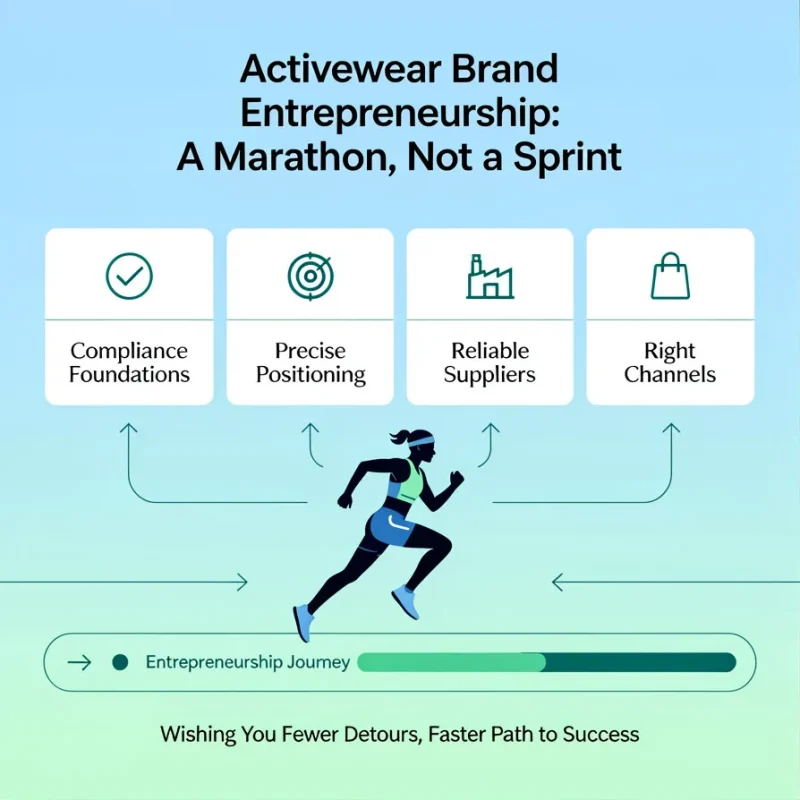
Building an activewear brand is not a 100-metre sprint – it’s a marathon. Every pragmatic decision you make in the early stages builds energy for future breakthroughs. From solid compliance foundations, to precise positioning, to reliable suppliers and the right channels – these four links are interdependent, and none can be overlooked.
Wishing you fewer detours and a faster path to a model that works for you on your activewear entrepreneurship journey.